

“Hey, Asad, is everything normal?” I asked, sensing the shift.
“Nope! The client no longer wants to work with us,” he replied, staring blankly at his screen.
This scenario is all too common. I have been working in the agency environment for 20 years, starting my career at Manhattan Leo Burnett. Throughout those two decades, the uncertainty of losing a client has been a constant ghost haunting even the best teams.
Most agencies believe the churn rate spikes due to price pressure, fierce competition, or unrealistic client expectations. They are wrong. In reality, clients don’t leave because results are bad—they leave because the value is unclear. Across marketing, SEO, and paid media agencies, the same pattern repeats: Unclear work → Unclear value → Mistrust → Churn.
In this guide, we will dismantle the traditional way agencies report to clients and introduce a framework—CRO Reporting—that not only stops the bleeding but actively helps you increase client lifetime value.
The Real Reason Agencies Lose Clients
To solve a problem, you must first diagnose it correctly. Many agency owners treat churn as an inevitable cost of doing business. They assume the client “ran out of budget” or “wanted to take things in-house.” While these excuses are comforting, they mask the uncomfortable truth: the client didn’t see enough reasons to stay.
The Hidden Cost of “Ghost Marketing”
Clients frequently complain: “Even though our sales increased, it might actually be the holiday season; it’s hard for us to spend such a good amount for this kind of Ghost Marketing.”
This term, “Ghost Marketing,” is the silent killer of retainers. It happens when an agency is doing incredible work behind the scenes—fixing technical SEO errors, optimizing backend code, or refining audience segments—but the client only sees a static invoice at the end of the month. Note: According to research by HubSpot, marketing agencies face an average annual churn rate of nearly 30-50%, significantly higher than other B2B service sectors. This suggests a systemic failure in demonstrating ongoing value.
Survey Data: What 125 Agencies Told Us
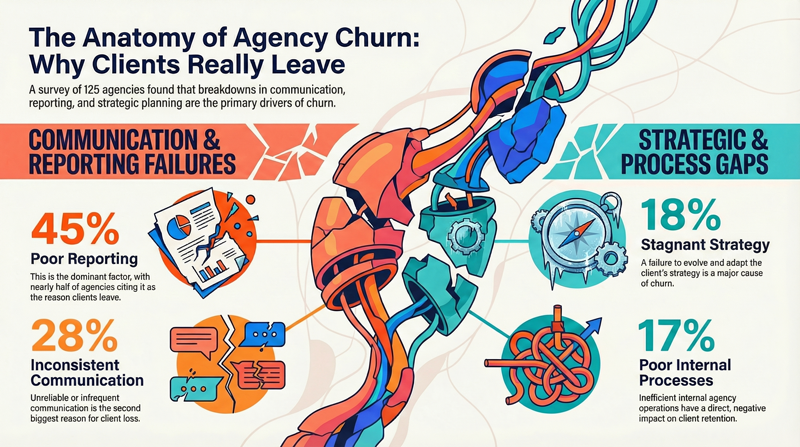
In a recent qualitative and quantitative study of 125 marketing, web, SEO, and performance agencies, we identified the primary blockers to retention. We asked agency owners and account managers: “Why did your last client leave?”
The survey revealed the following breakdown:
- Poor reporting — 45% (The dominant factor)
- Inconsistent communication — 28%
- Stagnant strategy — 18%
- Poor internal processes — 17%
- No clear roadmap — 10%
- Weak agency onboarding process — 7%
Initially, these appear to be unrelated concerns. However, upon closer examination, a distinct pattern becomes evident. “Inconsistent communication” is often just a nice way of saying “I don’t know what you’re doing.” “Stagnant strategy” usually means “You haven’t shown me new insights.”
In fact, 64% of agencies are actually struggling with reporting clarity—even if they don’t label it that way. To reduce customer churn rate, agencies must address this visibility gap immediately.
[1] The Narrative Shift in Agency Reporting
[2] The Revenue-Linked Agency Pricing Strategy
The 4 Pillars of a High-Value CRO Report
Clients don’t want long reports; they want clear answers. Whether you use sophisticated marketing agency reporting software or a manual presentation, your report must be built on these four pillars to be effective.
Pillar 1: Revenue Impact (The Money Metrics)
This is the “Executive Summary” slide. It answers the question: Did we make money?
Most agencies bury this data. It should be slide #1.
- Did conversions increase?
- How much money did optimization add?
- Key Metrics: Conversion volume, Revenue uplift, Profit impact.
By leading with revenue, you anchor your agency’s value to the client’s bank account, not their website traffic logs.
Pillar 2: Traffic Efficiency (ROAS & CPA)
This section proves you are a responsible steward of their budget. It answers: Are we doing more with the same spend?
- Show how Return on Ad Spend (ROAS) is improving month-over-month.
- Highlight decreases in Cost Per Acquisition (CPA).
- Key Insight: If traffic went down but revenue went up, this section explains that you filtered out low-quality traffic to save them money.
Pillar 3: Experience Health (Funnel & Friction)
This is where you show your expertise. Explain conversion funnel analysis and drop-offs.
- Focus on behavior: “We noticed users are rage-clicking on the checkout page.”
- Focus on friction: “The mobile load time is killing 15% of sessions.”
- Key Metrics: Funnel drop-offs, UX issues, User frustration signals.
Pillar 4: Optimization Velocity (The “Work” Proof)
This answers the “What have you been doing?” question. It shows momentum through A/B testing results.
- Key Metrics: Tests launched, Insights discovered, Learnings applied.
- Even if a test fails, reporting on it proves you are active. “We tested X, it didn’t work, so we saved you money by not rolling it out.” That is a win.
Section 5: The Execution Gap — Why Most Agency Reports Fail
If the formula is so simple, why do 45% of agencies fail at reporting?
The Design Problem: Why “Excel Hell” Kills Retention
Knowing what to report is only half the battle. The other half is presentation.
Most account managers are not designers. They paste blurry screenshots into PowerPoint or send raw data exports. This kills the perceived value. A high-value retainer ($5k/month and up) requires high-value presentation. If your report looks cheap, your service feels cheap.
Clients suffer from cognitive overload. If they have to squint to read a chart or do mental math to understand a table, they will disengage.
The “Done-For-You” Solution vs. DIY
Agencies often fall into a trap:
- The DIY Route: The founder or Account Manager spends 10 hours a month wrestling with slides. The result is “okay” but time-consuming.
- The Automation Route: They buy software that generates generic dashboards. The client never looks at them because they lack narrative.
The smartest agencies take a third path. They use a proven marketing report template for the structure, and they outsource the design execution.
[Download the Free CRO Reporting Template Here]
I have packaged the exact structure discussed above—the Revenue, Efficiency, Experience, and Velocity slides—into a ready-to-use template. Stop reinventing the wheel.
Section 6: The Financial Impact — Pricing & LTV
Implementing this reporting structure isn’t just about keeping clients; it’s about charging them more.
Breaking the Pricing Ceiling
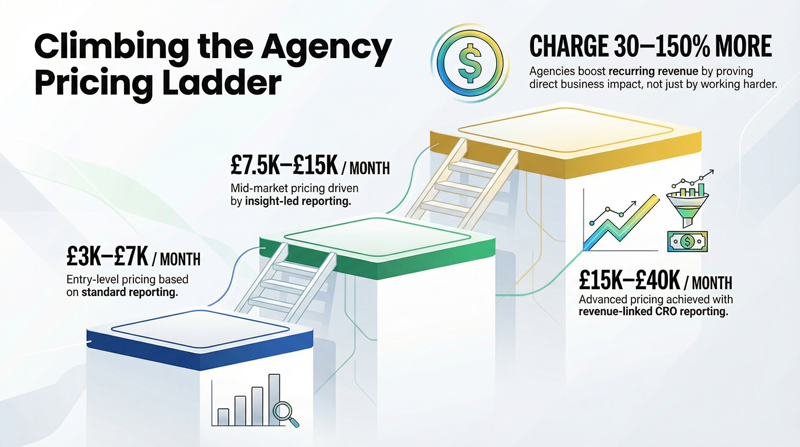
Agencies command higher pricing not because they work harder, but because they prove business impact. CRO reporting allows agencies to charge 30–150% more, boosting Monthly Recurring Revenue (MRR).
- Entry Level: $3k–$7k (Standard reporting)
- Mid-market: $7.5k–$15k (Insight-driven reporting)
- Advanced: $15k–$40k (Revenue-linked CRO reporting)
The Retention Flywheel
CRO reports naturally drive upsells. When you show a slide detailing “High drop-off on mobile checkout,” the client will naturally ask, “Can you fix that?”
Suddenly, you aren’t selling; you are solving.
Whether you offer custom solutions or white label marketing report services, upsells feel like: “Fixing what we already saw—to capture revenue we’re already losing.”
Conclusion
The difference between a churning client and a lifetime partner is rarely about the quality of the SEO or PPC work itself. It almost always comes down to client retention strategies rooted in clarity, communication, and trust. When customers feel confident in your narrative, your value becomes undeniable. CRO reporting is the bridge between delivering strong results and building trust that turns short-term contracts into long-term partnerships.
Clear CRO reporting helps agencies improve customer retention by showing how marketing strategy directly impacts real customer bases, revenue, and the performance of products or services across the entire customer journey. Instead of guessing, clients see how optimization improves customer engagement, increases customer lifetime value (CLV), and helps retain customers month after month.
Don’t let poor reporting or bad design undermine your efforts to improve customer retention.
Step 1:
Click here to download my Monthly CRO Reporting Template
This template gives you the structure you need to confidently communicate results, strengthen customer support conversations, and help customers feel aligned with your strategy.
Step 2:
If you’re a scaling agency looking to simplify operations, white label CRO services can remove the reporting burden entirely. I specialize in designing high-end CRO reports and client acquisition decks that transform raw data into a compelling visual story. This approach supports stronger client retention strategies, improves customer engagement, and clearly demonstrates how your work increases customer lifetime value (CLV).
Contact Me for Custom CRO Report Design & White Label CRO Services
Frequently Asked Questions
Q: How does CRO reporting reduce customer churn rate?
A: CRO reporting reduces churn by shifting the focus from vanity metrics to outcomes that matter across the customer journey—such as revenue growth, conversion efficiency, and long-term customer lifetime value (CLV). When customers feel informed and supported, it strengthens customer support, reinforces building trust, and makes clients far more likely to stay, even during market volatility.
Q: What is the best marketing agency reporting software to use?
A: Tools like Looker Studio, AgencyAnalytics, and Databox are useful for data collection, but they don’t always help retain customers on their own. The most effective approach combines these tools with a well-structured presentation that connects marketing strategy to customer engagement, revenue impact, and real business decisions.
Q: Can I use a white label marketing report for my agency?
A: Absolutely. White label CRO services and white label marketing reports allow agencies to deliver enterprise-level reporting under their own brand. This strengthens perceived authority, improves customer retention, and helps agencies serve growing customer bases without expanding internal teams.